Showing posts with label CIMA PM. Show all posts

Sunday, August 5, 2012

Relevant Cost & Short term decisions

Relevant Cost & Short term decisions

Relevant Cost ~ "Costs which are affected by the decision being taken"
In other words ‘the amount by which costs increase and benefits decrease as a direct result of a specific management decision"

Before the management of an enterprise can make an informed decision on any matter, they need to incorporate all of the relevant costs which apply to the specific decision at hand in their decision making process.

Identifying relevant and non-relevant costs


The identification of relevant and non-relevant costs in various decision-making situations is based primarily on common sense and the knowledge of the decision maker of the area in which the decision is being made.
 
  Non-relevant costs
    -Sunk costs
    -Fixed overheads that will not change due to the decision
    -Committed costs
    -Depreciation
    -Notional costs

Are variable costs always relevant costs ? No, if the variable costs have already been incurred (sunk costs) or if the variable cost wont change due to the decision been taken (committed costs)

Are fixed costs always non-relevant ? No, if there is an incremental fixed cost due to the decision been taken then that incremental fixed cost will be relevant.

Opportunity costs ~ "value of the next best alternative sacrificed by the decision"

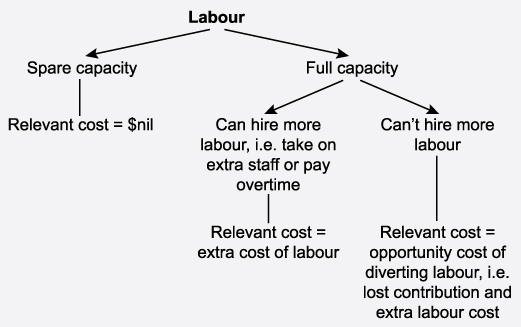
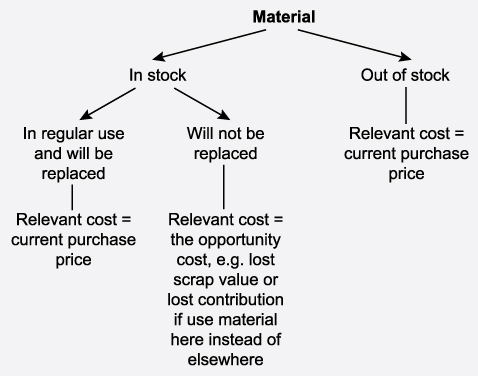
Calculating relevant cost of resources,
    If available in stock & regularly used: replacement cost
    If available in stock & not used: Zero
    If not available in stock: purchase price

Minimum price quotation to special projects = Relevant cost of the project

Friday, August 3, 2012

Learning curves

When a complex and repetitive process is done by humans the time taken to complete one iteration of the task will reduce by a fixed amount as the number of times its repeated increases. In simpler words, when a task is done over and over again, if can be done faster.

Analyzing this phenomenon is done under learning curves with the use of a mathematical model
Learning percentage is the percentage by which the total cumulative time taken would reduce when the output level is doubled
Example, If the time taken to produce one unit is ‘t’ and the learning curve is 80%
According to the definition above when producing 2 units, the average time taken for one unit would be,           
It is important to understand that this is the average of producing the 2 units
So the total time taken to produce both units would be, t * 80% * 2

Using this method we are able to calculate the times taken to produce when the output level is doubled only. 
Learning curve plotted in respect with cum.average time per unit versus number of units
If both axis variables log values are plotted again, it can be seen to have a linear relation
This linear relation could be used to derive the formula below

Learning curve formula

           
Where Y – Cumulative average time taken per unit
            a = Total time taken for the first unit
            X = total number of units
            b = index of learning

 
Learning curve becomes essential when calculating time taken when the output level cannot be achieved by doubling the first output level (as done previously)
It is important to keep in mind that, the solution we get to Y is the cumulative average of the time taken for one unit,
It is NOT the time taken to produce the last unit
If the time taken to produce the last unit is needed, we will have to follow the bellow method,

Example: Assume we need to calculate the time taken to produce the n’th unit, the first unit took t’ amount of time. And the leaning curve is 80%
           
            Cumulative average time for producing n units =
            Total time taken for producing n units = unit time * number of units =  

Now we know the time taken to produce n units. If we find the time to produce n-1 units, the difference between them should effectively give us the time taken to produce the n’th unit. 
            Cumulative average time for producing (n-1) units =
            Total time taken for producing (n-1) units = unit time * number of units 
                                                                           =

There for the time taken to produce the nth unit = time taken for n units – time taken for n-1 units
                       

This done by variables would seem quiet comprehensive, but when solving a question with given figures following these steps logically is quite simple. Try to grasp the concept of how we arrived at the solution.

Uses of the learning curve

  • In circumstances where the learning curve is likely to apply like complex assembly operations
  • When preparing budgets the effect of the learning curve should be considered
  • Can be used as a rational basis for price negotiation and cost control 

Important points to keep in mind when faced with a learning curve problem

  • Learning curve is concerning the reduction of time per unit, NOT the cost per unit
  • If labour is working in a machine set phase, for an example in a belt driven lineup, there is no possibility for learning curve to exist
  • Learning is assumed to automatic, but the attitudes of the management and the commitment of the workforce would have a great impact in achieving this


The value chain – TQM

The value chain – TQM

Continuous improvement 

This is a change from the traditional perspective to achieve predetermined standards and strive for continuous improvements. Target costing , Kaizen costing could be seen as examples

Kaizen costing

Kaizen costing is concerned about reducing costs incurred in the production process through increased efficiency and lower waste.
Because most of the products cost is determined in the designing stage the cost reductions achievable in production stage (Kaizen) would be comparatively smaller

Value analysis

Value analysis is the process of identifying the actual value of features in their products to the customers.

Functional analysis

Company would breakdown its product into the separate functionalists it provides, then the analyze the amount customers are willing to pay for that function.  If providing the function costs more than that amount appropriate measures should be taken to either reduce the cost or to eliminate the function entirely.

 Value chain


Just in time concept

Just in time is a philosophy of having nearly zero inventory by purchasing only when material is needed for production and producing only when the products are requested by the customers. Hence JIT could be, just in time production or just in time purchases
This is there for a pull system as opposed to the traditional push system


For a successful JIT implementation

-          Versatile and multidisciplinary workforce
-          Strong supplier relations to get the suppliers supplying regularly and to have the quality of the supplies be checked by the supplier.
-          Good communication between teams in the organization
-          Get it right the first time – zero defects approach
-          If some problem occurs in one part of the production line up the whole production would stop, this could be seen as a problem of the JIT system, but since this happens the whole company would then forces on getting the proper solution to the problem

Total Quality Management

The main idea here is that, Quality is the main attribute for gaining competitive advantage.
There are measurable costs concerning quality

External costs
-          Loss of customer goodwill
-          Manufacturing costs of failed goods
-          Repair costs
-          Liability claims

Internal costs
-          Costs of scrap
-          Reworking costs
-          Manufacturing and process engineering required to correct the failures 

Appraisal costs
            These are costs associated with checking the products to confirm they are in the required standard

Prevention costs
            These are costs associated in making sure that defects don’t happen in the first place

Criticism of TQM, the main issue of TQM is that it is not a well defined set of instructions. It is rather a philosophy of culture within the organization. Many companies have failed trying to use TQM as a quick fix to their problems.
Business process re-engineering
Business process re-engineering involves inspecting a business process and making radical changes to that system in order gain reduced cost benefits improve quality and value of products.

Gain sharing arrangements

When a company doesn’t have the capital requirement to venture on a business, it may go for a gain sharing arrangement, where  two or more companies contribute for the business and the gain is shared amongst them.
Some problems firms may encounter when proceeding with a gain sharing arrangement are,
-          Agreeing the base line to measure gains
-          Agreeing on a way to proceed in the project
-          Sharing the gain
-          Measuring the gain reliably
-          Allowing other firms sensitive information

Thursday, August 2, 2012

CIMA PM Pricing


Pricing

Price elasticity of demand

The effect on the demand for a product when the price is changed

Demand curve

Elasticity of demand = - %change in quantity demanded / %change in price

Kinked demand curve situation 

 if a company increases price the demand will fall, but if the company reduces the price the demand won’t increase (because the competitors would reduce their prices)


Factors effecting price elasticity


- Scope of the market (larger the market the more inelastic)
- Information within the market (if the consumers don’t know about alternatives the demand could be inelastic)
- Complementary products
- Disposable income
- Necessities (inelastic)
- Habitual/addictive products (inelastic)


Product life cycle

Depending on the stage of the product life cycle different pricing strategies would be adopted

- Introductory stage - a penetration price or a skimming price in order to establish the product in the market


- Growth stage - trying to establish a dominant market share

- Maturity stage

- Decline – prices would fall when companies try to keep the product in the market


The profit maximizing model

Profits are maximized when the MR = MC
Price equation;                                                p = a – bX
Marginal revenue equation;                       MR = a – 2bX
In the above equations                                 
b = Rate of change in demand (slop of the curve) = Change in price / Change in demand
                                                                X = Quantity demanded
Limitations of the profit maximizing model


- Its practically impossible to generate a demand function
- The aim of the firms are to achieve a target profit, not the theoretical maximum profit
- Accurately determining the marginal cost is not possible
- Unit marginal costs are not constant and can change with the quantity
- Demand can change due to facts other than price


Total cost-plus pricing

Adding a markup to the total cost of producing one unit

Advantages        - The required profit would be made if the budgeted sales are made
-          Useful in contracts
-          Cheap and easy to use
-          Can justify increases in selling price

Disadvantages   - Finding a suitable way to apportion the fixed cost
-          If expected sales volumes are not met the overheads could be under absorbed
-          Competitor activities are ignored
-          Ignores the different stages of product life cycle

Marginal cost-plus pricing ~ Adding a markup to the marginal cost

Premium pricing ~ Charging a superior price due to product differentiation

Market skimming ~ Initially setting a high price and reducing the price with time

Penetration pricing ~ Initially setting a lower price than cost, intending to gain market share and then increase the price to make profits

Price differentiating ~ Selling the same product to different market segments for different prices, this could be done by,
-          Time (peak / off peak)
-          Quantity (small orders / bulk orders)
-          Type of customer (student)
-          Geographical location

Loss leader pricing ~ Selling the main product at a very low price and selling its complements at a very high markup to cover the losses

Product bundling ~ Selling few products as a bundle for a lower price in order to increase the sales volume

Using discounts in pricing ~ To increase the sales volume without permanently decreasing the selling prices

Controlled pricing ~ Where the price is enforced by the law, usually to make sure monopolistic companies don’t exploit their position in the market